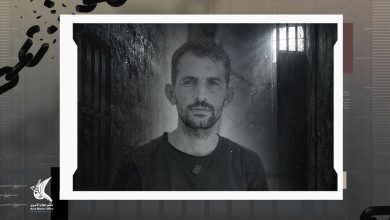
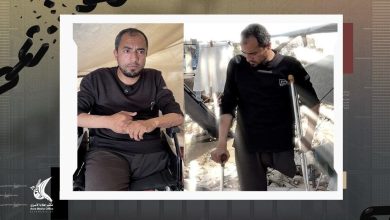
Thirty Years of Detention, Fourteen in Isolation: Documenting Medical Neglect in the Case of Hassan Salameh

Guards pulled Hassan Salameh from his isolation cell on August 13, 2026, put him on the bosta, the prison transport vehicle, and drove him to Ramle hospital. He thought he was finally going for treatment. They beat him hard as he stepped down from the bosta, he says, then moved him to the Ramle transit unit. No examination. No procedure. Nothing.
“My condition is closer to death,” he says.
Salameh has been held in occupation prisons since 1996, much of that time behind the door of a solitary cell. His health is breaking down, and he says the repression and the denial of medical care have not stopped.
Ghufran Zamel, his fiancée and herself a released prisoner, passed on a recent letter from him. He still feels the beating, he says. Nobody examined him at the hospital. Back in isolation at Ganot prison, he asked to be photographed so the marks could be documented. Refused.
He asked for a doctor. The doctor came “from behind the doors,” he says, and left him a painkiller.
30 years behind a closed door
Salameh was born on August 9, 1971, in Khan Younis refugee camp in the southern Gaza Strip. Occupation forces shot him in Hebron on May 17, 1996, and arrested him there. Interrogation ran about four months. Sentencing came in 1997: 48 life sentences, one of the heaviest terms ever handed down against a Palestinian prisoner.
He has spent about 14 years in solitary confinement, in two stretches. The 2012 prisoners’ strike ended the second. Isolation came back in recent years.
Since the war on the Gaza Strip broke out in October 2023, he has been in solitary again. Zamel has said before that guards beat and abused him during transfers between isolation wings.
A letter he sent from Ganot in July 2026 set out what men in isolation live with. Guards raid the wing, search it, and assault the men, over and over. The food keeps getting worse. The exercise yard is too small, and prisoners are cut off from one another.
A year of illness, and no treatment
The beatings are not the whole of it. The same letter describes what is happening to his body. Diarrhea for about a year, and nothing given for it. An endoscopy he needs and has never had. Eyesight weak enough that reading has become hard, and no glasses.
He needs dental work too. The only option put to him was extraction. The dentist comes to the isolation wing once a month.
Palestinian prisoners’ institutions reported in August 2026 that guards at Ganot beat prisoners and crack down on them. The men have no health care and not even the most basic personal supplies. Living conditions are harsh. The punishment does not let up.
The world of barzakh
His name has been bound up with solitary confinement for so long that in his memoirs he called life inside the cells something close to “the world of barzakh.” Thousands of days away from other prisoners.
Palestinian sources say his family has managed to visit him twice in all his years in prison. Zamel was barred from visiting for long stretches. The two signed their marriage contract in 2010, when both of them were prisoners. He lost his mother, Khadija Salameh, in March 2024.
He could not say goodbye.
Moved from prison to prison
The Prisoners’ Media Office reported in July 2026 that the occupation prison service had moved a group of prisoners serving life sentences, along with leaders of the prisoners’ movement, into isolation at Ganot. Salameh was among them. The shuttling between Megiddo and Ganot goes on, the office said, making it hard to track prisoners’ conditions or arrange lawyers’ visits.
From May 17, 1996, to today, Salameh’s life has been prison, isolation, and sickness, with nearly everything else taken from him. He is 55. His documented birth date, August 9, 1971, means he does not turn 56 until August 2027.
His latest letter says the assault at Ramle hospital is not where it ends. Guards refused to photograph his injuries. No one has run any tests. He gets painkillers and nothing more. His condition, he says, is “closer to death.”
His case turns attention back to prisoners held in isolation, above all those serving the longest sentences. Palestinians have asked international and human rights organizations again and again to step in, to make sure prisoners get medical care and to protect them from assault. They have asked for monitoring of the conditions prisoners are held in.