Legislating Execution: Israel’s Death Penalty Bill and Its Target

Israel’s Knesset is closer than ever to passing a death penalty law aimed at Palestinian prisoners. The National Security Committee has approved an amended version of the bill, clearing it for second and third readings. A final vote in the general assembly could come as early as next Monday.
The bill mandates execution within 90 days of sentencing and bars any possibility of pardon. No death penalty legislation has ever advanced this far in Israeli history.
The proposal is not new. It was reintroduced in 2022 and passed a preliminary Knesset reading in 2023. In September 2025, the National Security Committee approved it for a first reading. It then cleared the full Knesset and entered a final amendment phase, with intensive lobbying underway to secure a clear majority from coalition and opposition members. The government is pushing to fast-track the vote.
This legislative push reflects a broader shift in how the Israeli occupation handles Palestinian prisoners, one that moves from field-level repression to formal legal codification.
I. The Death Penalty Bill: An Escalating Legislative Track
Provisions of the proposed law
The bill imposes the death penalty on anyone who intentionally, or through recklessness, causes the death of an Israeli citizen when motivated by national or racial hostility or by intent to harm the State of Israel.
Its most dangerous provision strips away the requirement for judicial unanimity. A simple majority of judges can now impose a death sentence. Once final, the sentence cannot be commuted or reduced. This is unprecedented.
The bill’s language ties the offense to harming “the State of Israel as the state of the Jewish people,” a formulation that makes its discriminatory intent plain and confirms it targets Palestinians specifically. Israeli settlers who commit crimes against Palestinians are effectively excluded.
The legal and human rights position
Palestinian prisoner institutions call the bill an unprecedented escalation, a new attempt to dress up crimes in legal language. Israel, they say, is behaving as an entity above accountability, particularly given the clear failure of international mechanisms to intervene.
The death penalty is prohibited under multiple international conventions and treaties. It constitutes a war crime under the Fourth Geneva Convention of 1949 and its First Additional Protocol.
Israeli law does permit capital punishment in certain cases. It has been applied once: against Adolf Eichmann. The Israeli Supreme Court has overturned other death sentences in the past.
Israel’s insistence on codifying this measure confirms its open disregard for international law and basic humanitarian norms.
II. Itamar Ben Gvir’s Role in Driving the Legislation
Itamar Ben Gvir, Israel’s National Security Minister, has a long record of anti-Arab activism and support for racist policies, including multiple charges and convictions. Since taking office, he has pushed extreme policies and legislation targeting Palestinians broadly and prisoners specifically. He represents the far-right wing of Israeli politics that seeks to force its ideological agenda into law.
Ben Gvir’s influence goes well beyond the death penalty bill. He has been a driving force behind several measures that directly harm Palestinian prisoners:
The annulment of the Oslo Accords, Hebron Protocol, and Wye River Memorandum. Ben Gvir submitted a bill to the Knesset to cancel these agreements, claiming the goal was to “correct an injustice that has lasted for many years” and “restore Israel to its previous status,” including reclaiming transferred territories. If passed, this law would redefine the relationship between Israel and the Palestinian Authority and sharply increase pressure on Palestinians.
Expanded powers for the National Security Minister. The Knesset approved additional authorities for Ben Gvir related to unlicensed construction, giving him more leverage over issues that directly affect Palestinian communities.
Deliberate prison overcrowding. Ben Gvir has enforced a policy of packing Palestinian prisoners into overcrowded cells, compounding their physical suffering and psychological harm.
Deliberate food deprivation. In a rare ruling, Israel’s Supreme Court found that the Israeli government was intentionally denying thousands of Palestinian prisoners the minimum food required for survival. Ben Gvir himself acknowledged the policy: “We will continue to provide the minimum conditions required by law for the terrorists imprisoned in our jails.”
Ben Gvir frames these policies as “restoring security for Israelis.” The actual aims go further. They target Palestinians, strip them of their rights, codify racist practices, and entrench a system of apartheid.
Many analysts describe this legislation as a product of institutional hysteria within the Israeli establishment, exploiting the current moment to ram through discriminatory laws. The policies are packaged as security measures. At bottom, they aim to strip Palestinians of their rights within a broader project built on discrimination.
III. The State of Emergency as Legal Cover
Since declaring a state of emergency on October 7, 2023, the Israeli government has acquired sweeping exceptional powers. Extended through December 2025, the emergency framework allows it to bypass numerous legal constraints.
The impact on prisoners has been direct. Administrative detentions have surged to levels not seen before. Torture and mistreatment have worsened. Conditions of detention have deteriorated by every measure.
The state of emergency serves as legal cover for repressive policies and legislation. The death penalty bill is one of them.
IV. Prisoners by the Numbers: Updated Data
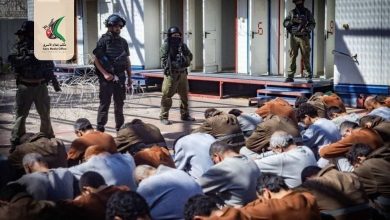
More than 9,500 prisoners and detainees are held in Israeli occupation prisons as of early March 2026.
Among them: 79 women, 350 children held in Megiddo and Ofer prisons, and 3,442 administrative detainees, roughly 36% of the total. Another 1,249 are classified as “unlawful combatants,” a figure that does not include all Gaza detainees and also covers Arab detainees from Lebanon and Syria.
Slow execution as systematic policy
For years, Israel has pursued a policy of slow-killing against prisoners through medical neglect, starvation, and torture, resulting in dozens of deaths inside prisons.
The death penalty bill now threatens to convert this de facto policy into written law, giving it official sanction.
The Prisoners’ Media Office response
The Prisoners’ Media Office condemned the Knesset National Security Committee’s approval of the bill, calling it a dangerous and unprecedented escalation in occupation policies against the prisoner movement.
The bill imposes execution without unanimity, mandates implementation within 90 days, and denies any possibility of pardon, the office said. It reflects a retaliatory logic aimed at the physical elimination of prisoners and constitutes a flagrant violation of international laws and conventions.
The Prisoners’ Media Office called on Palestinian authorities and the international community to act immediately to stop this law. It held the occupation fully responsible for any consequences and stressed the need for the Palestinian people to stand united in defense of the prisoners.
Conclusion
What is unfolding is not a matter of tighter regulations or isolated legislation. It is a concerted drive to reshape the legal framework governing Palestinian prisoners, with execution at its center. The death penalty bill is the sharpest instrument in this effort: a tool designed to formalize existing practices and give them the weight of law.
These laws meet a ground-level reality already defined by escalating violations, making the current phase among the gravest Palestinian prisoners have faced. Action on both legal and human rights fronts is urgently needed. The trajectory, if unchecked, threatens the lives and basic rights of thousands.